Everything consists of spacetime.
We already discussed quantization in Chapter 3 on the limits of spacetime. In Section 3.7.3, the quantum of action h was derived from the low-dimensional limit. There, we only discussed the area that was relevant to the low-dimensional limit. Here, we will add the other properties of QM. Therefore, this basic element, based on my subjective selection, comes at the end.
Unfortunately, the quantum of action h is not sufficient for quantization in QM. An important aspect is still missing. On the one hand, we must discuss that in our spacetime, gravity can never be represented by exchange particles. On the other hand, we must discuss why it only works in QM via exchange particles. But then again, it does not work in entanglement.
As always, we start with the simple things and summarize Chapter 3 for the interface.
The amazing thing about our approach is that we necessarily start with continuous and differentiable spacetimes, and in a single spacetime there is no infinity, no zero, no singularity, and no quantization. However, the interaction across the dimensional boundary generates the familiar QM. Here are the key characteristics of the boundary again:
The most important formula for us here is: l_P\space *\space m_P\space *\space c\space =\space h as the quantum of action and without the dimensional transition (the speed of light) as Compton wavelength (state) then l_P\space *\space m_P. For the Compton wavelength, only the division into mass and change in wavelength can be divided differently in the low-dimensional. However, the state after the process (collision) in our spacetime must always be Planck mass * Planck length. The process itself can occur in the size of h or a multiple thereof. The interface does not allow for anything else. The geometric characteristics in 2D play almost no role here. We can only determine spacetime density, and this spacetime density must always adhere to h when changing from the low-dimensional. We don’t want to dwell on this any further and will move on to the new and exciting topics.
In our spacetime, there can be no exchange particles for gravity. The graviton, desired by many, is not possible in DP. Particles, regardless of their form, only arise via the low-dimensional interface. Gravity is a deformation of spacetime itself without changing the spacetime density. Gravity and also the dissolution through the opposite deformation thus have no influence on spacetime density. Therefore, they also have no influence on a low-dimensional image. The exchange particle for gravity would have to be a real 3D particle. This presents us with two problems:
In DP, gravity continues to be a deformation of spacetime. Then the graviton would have to interact with spacetime itself. How does gravity then get an infinite range? The graviton can interact with spacetime immediately after the spacetime density. How are the gravitons supposed to know that many close to the spacetime density and few further away have to interact with spacetime?
In an electric field, photons must react to another electric field. If there is none, then the range is infinite. With the graviton, however, spacetime is always present as an interaction partner. You can twist and turn this as much as you like. The idea of an exchange particle for gravity and a geometric mapping in spacetime itself are mutually exclusive.
The next problem is energy. Mass, charge, etc. differ for each exchange particle. But all exchange particles transfer energy. With gravitons, it is not clear where this energy should come from. With photons, the energy comes from the change in state of the spacetime density. The electron can change its orbital or its spin. It can also come from a momentum that changes during scattering. In gravity, the change in the energy of the spacetime density from one spacetime curvature to another is zero. Where should the energy of the exchange particle come from and go to? But an exchange particle without energy also makes no sense.
More than two points could be mentioned here. However, the above discussion should make it clear: in DP, an exchange particle for gravity is not possible.
Then we must continue with the opposite here. Why can all state changes in low dimensions occur only and exclusively through exchange particles? As always, this is due to the limits of spacetime. In low dimensions, we always have separate spacetimes.
If one spacetime produces an effect through a special spacetime geometry, the other spacetimes cannot react to it on their own. Two separate 2D spacetimes can overlap at most via a 1D spacetime. The overlap of spacetimes always occurs at (n-1) spatial dimensions. However, we cannot map spacetime density in 1D. The two spacetimes themselves cannot communicate directly with each other. Here, an exchange particle must take over this interaction. However, an exchange particle is nothing more than a 2D mapping.
The whole thing can only work if these 2D spacetimes are connected via a 3D spacetime. Without this higher-dimensional spacetime, there can be no exchange particles. In addition, there must be a change in the state in the 2D mapping. This means that when, for example, an electron reacts to a photon, these two separate mappings become a new mapping in a 2D spacetime. The photon with its energy in 3D is depleted. More on this later in the section on interactions. For now, it suffices to say that an effect between the separate low-dimensional spacetimes themselves only works via separate exchange particles.
In gravity, there can be no exchange particles, as this is a change within spacetime. In QM, all effects are an exchange of separate spacetimes, which in turn can only exchange an effect through a 2D image. The images in 2D are fixed. Nothing happens within 2D. The image in 2D must be recreated with each interaction.
Now the idea behind entanglement comes into play again. In entanglement, the mappings in 2D are identical. If this mapping changes, then these superpositions change without the exchange of a particle. Therefore, the reactions are without an exchange particle and thus without information.
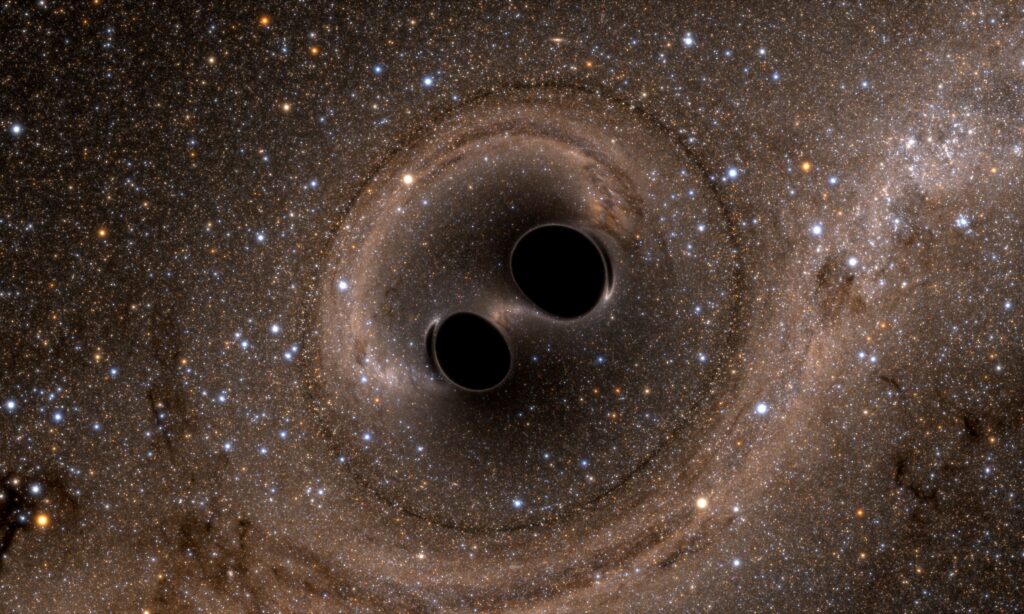
Hey, we still have gravitational waves. They have energy and change gravity. Isn’t that what we were looking for? A clear yes and no!
Let’s first take a look at how a gravitational wave is generated and what it is. A gravitational wave is triggered by the acceleration of mass. By any acceleration of any mass. Even when I’m just typing on the keyboard, I’m accelerating a small mass of my body. This triggers gravitational waves. These are extremely weak. Here you have to remember the motivation for the DP right at the beginning. These are the 10^42 difference between gravitational force and the next strongest force, electrical force.
When we apply acceleration to an object, we change the spacetime definition of that object in a certain direction. This means we change the distribution of spacetime density across spatial dimensions. This is a shift in spacetime density for the object, and gravity reacts to it. Energy or spacetime density is not lost and can only shift. It shifts away from one spatial dimension and towards another.
During this process, the object changes its state of motion. This means that the object is no longer where the change took place. Part of the change remains at a spacetime point where the spacetime density no longer exists. This means that part of the energy of the change is retained at that spacetime point. However, the reason for the change no longer exists there. The change propagates as a spherical surface through spacetime at the speed of light. In the process, the energy is greatly diluted. We do not measure energy, but rather the resulting gravitational wave. In the gravitational wave, we see the shift of energy to the spatial dimensions.
Information is exchanged via energy. This sounds like exchange particles, and in principle we could see it that way. However, the exchange particles of QM are always exchanged between separate spacetime configurations and not within a spacetime. Our spacetime is therefore a very talkative object. Any shift in spacetime density between the spatial dimensions is made available to the entire spacetime via gravitational waves. More exchange of information is probably not possible.
Something is happening, but not what we would expect for an exchange particle. As just mentioned, this is not an exchange between spacetimes. The gravitational wave has a clear sender, but no clear receiver. In QM, the exchange particle is completely absorbed by a receiver. Here, the receiver is the entire spacetime, without the gravitational wave being absorbed. It only thins out.
What about the Higgs boson? It is supposed to give elementary particles their mass. Gravity reacts to this. Is the Higgs boson then something like the graviton? Yes, but not for gravity. We will discuss the Higgs boson in more detail again in the section on exchange particles. For classification purposes here, it is sufficient to view the Higgs boson as an exchange particle between 3D spacetimes. We have black holes, which means we are embedded in a 4D spacetime. This means that there are an infinite number of separate 3D spacetimes. Like 2D spacetimes, these must react with exchange particles. This is what our Higgs boson will do. However, the reaction is not to gravity, but to spacetime density between the 3D spacetimes. Therefore, it appears that the Higgs boson assigns the property of mass. It is the only true 3D boson we know of. However, it is not an exchange particle for gravity within a spacetime.
We often hear statements such as: “In QM, everything is quantized.” Unfortunately, this statement is incorrect. Even in QM, the representation of a property can be continuous. In the worst case, it can be mixed: continuous and quantized, e.g., in the case of different energy levels in the representation of momentum. In fact, this is one of the reasons why mathematics in QM is so difficult. If everything were always quantized, it would be easier.
Let’s take the binding energy of an electron to its atomic nucleus as an example. As long as the electron is not “captured” by the atomic nucleus, the electron’s energy spectrum is continuous. There is no quantization. Of course, the momentum of the electron is in 3D and is not subject to quantization. How much energy is contained in the momentum is not quantized. The situation is completely different when the electron is “captured” and must form a common state with the atomic nucleus. Then the atomic nucleus and the electron must undergo an adjustment at the 2D level. You probably remember that excess energy from the overlap of spacetime densities must be released. This release takes place via another 2D mapping. This means that all participants must redistribute themselves across the dimensional boundary. This can only be done by quantization.
As a simple rule of thumb, we can note that
Here, too, our approach keeps the basic concept of QM very simple.