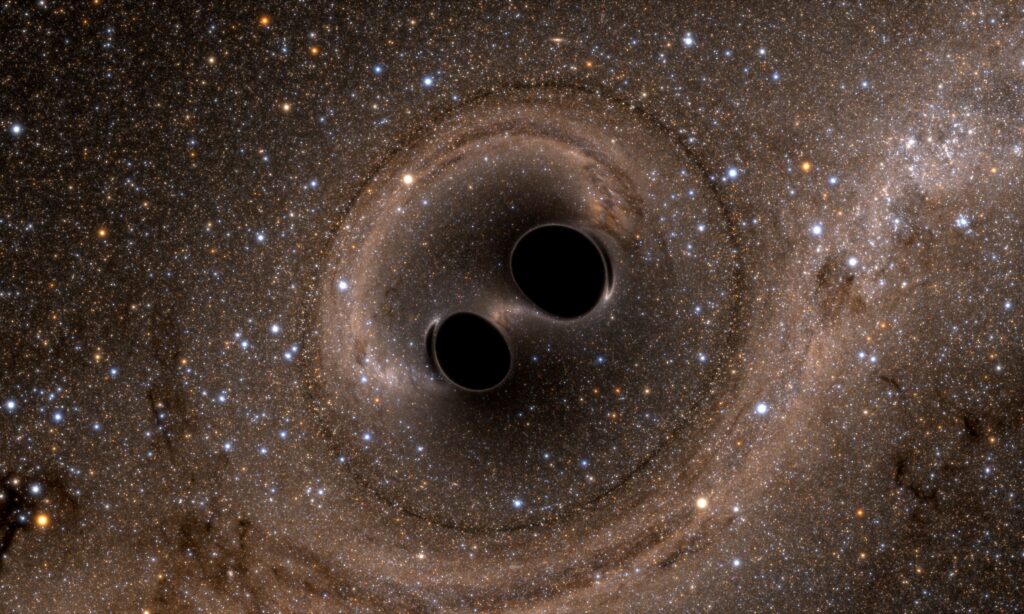
Everything consists of spacetime.
Let’s continue with entanglement. This property is the least understood ingredient of the entire QM. Superposition and uncertainty are not discussed as much or as controversial as entanglement. In DP, we will be able to explain entanglement very easily. Without the approach from DP, it is logically impossible to find a reasonable explanation for it. Let’s start again with an explanation of entanglement.
Like uncertainty, entanglement arose from mathematical investigations of QM. To explain the hydrogen atom or the double slit, entanglement was not necessary in the first step. Unlike superposition, it did not have to be incorporated into the mathematical model. This only became apparent later.
Entanglement has an additional important property. This only applies to more than one particle. Superposition and uncertainty already apply to us in the case of a single particle. Entanglement only really makes sense with two or more particles. From a QM perspective, it completely couples at least two particles together. Completely, because the separate particles are described by a single wave function. If you like, these particles are not separate at all in QM. This is where the problems of understanding begin.
Let’s take an electron as an example again. But now let’s take two electrons that are entangled. If we measure one electron as spin up, then the other electron must necessarily have spin down. This happens instantaneously and independently of the distance between the two electrons. It is important to note that one electron did not have spin up from the beginning and the other had spin down. The superposition principle also applies to entangled electrons. Each electron carries both spins until measurement. The electron that is measured first thus generates the exact spin for both electrons. As mentioned, this happens instantaneously over any distance. Don’t the electrons then have to exchange information about the measurement? I was measured as spin up, so you must spin down. It is precisely this “exchange of information” that is the problem in understanding entanglement. It would then have to take place at faster-than-light speed. According to QM, with infinitely fast information transfer.
We will not go into the various points of discussion on this topic, such as Bell, ERP, hidden variables, etc. This is also a point where GR and QM do not really fit together. Although Einstein helped to launch QM, he could no longer follow the theory at this point. An effect between two particles at faster-than-light speed is contrary to every principle of SR and GR. This was referred to as spooky action at a distance.
So does entanglement show that the assumptions of SR and GR are wrong, or something else? A clear yes and no! It quickly became apparent that when entanglement is used exclusively without an additional information channel, no usable information can be transmitted. The effect on electrons with spin up and spin down is transmitted instantaneously, contrary to the assumption of GR. However, GR (as understood without DP) defines that no information can be transmitted faster than light. Since we need a second channel that adheres to the speed of light for information that is usable to us, everything is fine again according to GR. That is the prevailing doctrine.
In my opinion, this interpretation has rather prevented the actual search for a solution. The problem has not been solved. The solution was to please everyone with this interpretation without creating a conflict between the theories. In the later chapter on the double-slit experiment, this solution hits us again with full force. There is a variant with “delayed choice.” It is even claimed that QM can determine something backwards in time. This is a philosophically terrible idea and 100% contrary to the assumption of DP.
Let’s try to find a better solution. Our first approach is to look at the ways in which we can entangle particles. This is usually achieved using two methods:
In both cases, the aim is either to start from a single spacetime density or to bring separate spacetime densities very close together without interference. For entanglement, we need to superimpose spacetime densities. This brings us to the solution.
For each particle, we have a spacetime density in 3D and additional 2D images. If the 3D images are very close to each other or originate from the same spacetime density, these spacetime densities can overlap. This happens in 3D. As we saw with the tunnel effect, due to the “wave representation,” the superposition can already begin when we would not yet consider them to be completely superimposed. Then there can be common images in 2D for two separate 3D spacetime densities. Not only can there be common images, but there must be common images. Each separate spacetime density in 3D occupies an intersection of the total volume in its volume. The 2D images from the 3D spacetime density must therefore be identical. We obtain exactly one superposition for separate 3D spacetime densities.
Why does the entanglement remain intact when we separate the particles spatially in 3D? As always, the dimensional interface takes care of this for us. We do not obtain any time or geometric information such as length or distance via this interface. How can a 2D image recognize for itself that there are separate representations in 3D? The clear answer: it cannot. In 2D, there is neither the distance nor the time from 3D. With this solution, we can once again make demands on entanglement:
This gives us all the experimentally confirmed properties of entanglement. Again, the discussion about whether entanglement is local or non-local is meaningless. Entanglement takes place in different spacetime configurations in which the term “local” cannot be applied.
If we look at the historical dispute between Einstein and Bohr on QM and GR, we can already see that, as so often in life, both were right. In QM, certain things happen instantaneously. In our spacetime, it is not possible to transmit information faster than light. However, both work together in separate and dimensionally different spacetimes.
Is that all there is to it? Yes, exactly, there is no more to it than that. The entanglement, which has been poorly understood until now, is a necessary consequence of our approach to superposition. When separate spacetime densities come too close to each other or are generated from a single spacetime density, we almost always obtain entanglement. The properties of entanglement are not mysterious but must exist in exactly this way.