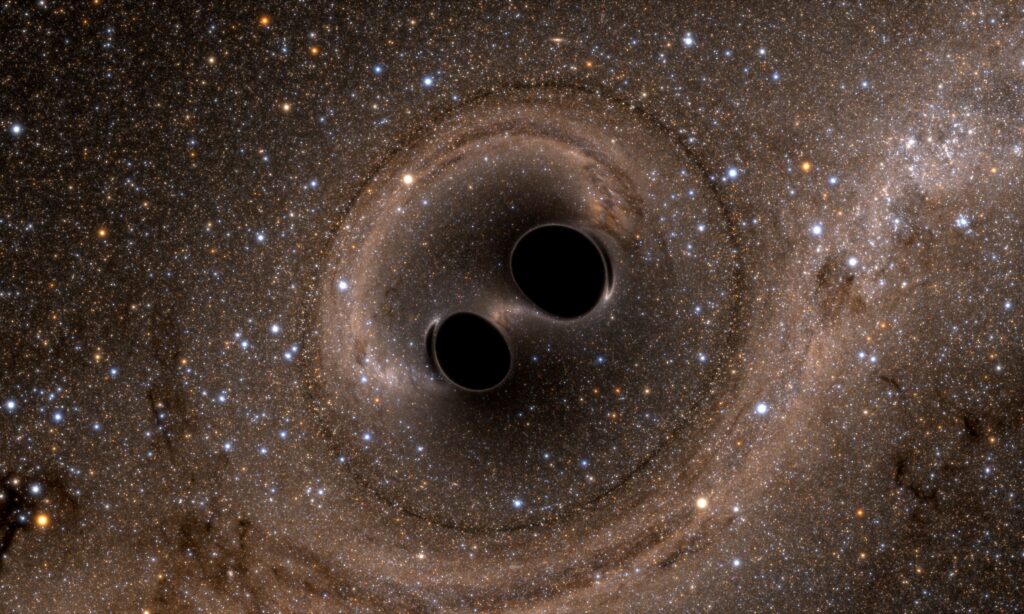
Everything consists of spacetime.
In DP, we want to achieve one of the most difficult things that can be attempted in physics. No, not unifying GR and QFT. That was just a starting point. The DP is so well developed that it is clear what we need to do given the current state of physics. We need to rethink some of the fundamentals of physics. Getting someone to do that is incredibly difficult. This is not only true in physics. Once something has been understood and thus dismissed as simple, no one wants to engage in a deeper discussion about it. This is exactly what we will have to do here.
The degree of difficulty is increased once again because the DP does not provide a new “highly scientific” mathematical model. Everything we need is already there. We want to achieve a new description of physics using well-known mathematical models. That sounds more like One Thousand and One Nights than a physical theory. We will look at the old descriptions given with a new perspective. It’s like a puzzle where you already know the names of all the individual pieces but still can’t solve it. You get partial pictures, but not the whole picture. This continues until the redeeming idea comes along. It’s not a 2D puzzle, but a 3D one, and everything fits together. With DP, we will need a little more. We will use spacetimes from 4D to 1D (note: in DP, only the spatial dimensions are counted) in different constellations. This will enable us to solve the physics puzzle.
The new logical connections in DP are so extensive that we can fully answer the following questions:
Stop! A list of questions like this could go on forever. We can see that these questions concern the foundations of physics. The starting point was a unification of GR and QM. Today, in 2026, we are certain that these two theories, with their current mathematical description, are fundamentally incompatible. It should therefore come as no surprise that the DP deals precisely with these fundamental considerations. If we do not need a new mathematical description and want to create a common basis, then there must be something wrong with the current foundations. This is where we come in.
The starting point was the idea of unification. Unification means bringing different things into one identity. The goal was to achieve this with as few different objects as possible. Taken to the extreme, this idea means having a single object for everything. Then there can be no more differences. Where do we start in this search? Here we have two different approaches to choose from:
Approaching a completely new theory was not the focus. The desired goal was the unification of GR and QM. It is easier to start with the known descriptions. Since GR and QM are the pillars of modern physics, we choose one of them.
Almost everyone looking for unification starts with QM. For most physicists, this approach has almost religious connotations. Their motto is: once we have quantized everything, we will have found the Holy Grail of physics. In fact, this approach makes sense. QM is the best-confirmed theory we have. In addition, QM describes all elementary particles and the interaction between them. Only one interaction is missing: gravity. We are certain that all statements about QM, such as probability, uncertainty, entanglement, linear mapping, etc., are 100% correct. We are equally certain that GR does not contain any of this. In addition, GR still contains such unsightly things as singularities. Hence the assumption that GR is not consistent.
Many brilliant minds have long sought a unification based on QM. The result has always been the same. The mathematical tools have been improved and knowledge has been generated. However, we have not come any closer to the actual solution. Therefore, as unlikely as it may sound, we choose GR as our starting point. What’s more, almost everyone who studies physics in depth develops a personal preference for one of the two theories. For me, this was GR. This adds another property to the “single object for everything” we are looking for. The image on this object should be geometrically describable. GR is a geometric approach
We have a rough idea of what we want to achieve and a starting point. Let’s take a closer look at GR. To do this, we will consider Einstein’s field equations. We will use the simplest form:
G_{\mu\nu}\space =\space k\space *\space T_{\mu\nu}
Oh, the first formula, don’t panic. We don’t need to be able to solve this equation. It’s about the structure and the objects used. On the left side is the Einstein tensor G_{\mu\nu}. This describes the curvature of spacetime. On the other side is k as a proportionality constant. We will come back to this in a later chapter. Then comes T_{\mu\nu}, the stress-energy tensor. If we look at this equation with our goal in mind (an object, geometric representation), then we have already completed the first half.
What was Einstein’s ingenious idea? To no longer conceive of gravity as a force, but to map it directly geometrically onto a single object, spacetime itself. For us, this means developing this idea further and transferring it to the other side of the equation. We have to find a geometric mapping in spacetime for the stress-energy tensor.
This means that the field equations on both sides describe a “deformation” of spacetime. One deformation is known as spacetime curvature. We will refer to the counterpart or source of spacetime curvature as spacetime density. This gives us our approach. We have a single object in the equation, spacetime. The equation describes purely geometrically a change in spacetime for the respective “deformation.” This does not change the calculations within GR. The equation remains as it is. We change our view of GR. The approach can thus be summarized very simply:
Everything consists of spacetime
We will obtain different and also infinite spacetime configurations in order to be able to map QM, but really all descriptions of nature are geometric mappings in a spacetime. Currently, there is a mnemonic for GR. It goes something like this: “Matter tells spacetime how it must curve, and curved spacetime tells matter how it must move.” Here, a clear separation between the stage (spacetime) and the actor (matter) can still be seen. A paradigm shift must take place. The new appropriate saying is:
Spacetime is not only a dynamic stage, it is also the only actor
The approach that any mass-energy equivalent is a spacetime density and thus a direct representation in spacetime will lead us to the most important conclusion in DP. Spacetime has boundaries. Not given by length or volume, but in its structure. Through SR, we will recognize that spacetime can lose a spatial dimension and the time dimension. Length contraction and time dilation to zero. The mapping of spacetime density across this spacetime boundary will necessarily generate all the elements we need for QM and explain the structure of GR:
Here, too, just stop! The list could be expanded by several points. However, we can already see from these few points that, in the new view of the dimensions of space and time, we must make a fundamental change in how we deal with these objects. There is a paradigm shift, but without new mathematics. We explain why the given mathematics must look exactly as it does. This is particularly important for QM.
The points listed are all a confirmation of GR and QM. There are no deviations in the observations. However, we can make experimentally testable predictions. For example, the last statement, that spacetime is a scalar potential field, results in observable changes for cosmology. The early universe must be different in some ways from our present universe. The latest observations from JWST can be explained very well with this.
This list could also be extended. However, the topics are dealt with in detail in the text.
As you can see from the introductory text, more text than formulas are used. This will remain the case. Formulas will be used in their simplest form when necessary. However, this is absolutely essential. A description without mathematics is not possible. To ensure that this text remains accessible to a wide readership, we aim to use a simple level of mathematics. This means that we are not doing mathematics here, but rather what we might call “a little bit of formula pushing.” We do not need to be able to derive or solve formulas such as the field equations mathematically. However, the structure behind them must be explained. The goal is to always know the reason behind all natural constants and formulas. A separate small section will be added shortly.
Not every detail from the physics textbook will be explained from scratch. Readers should be interested in physics and be able to identify the formula used in the introduction. For physics professionals, it may therefore seem “long-winded/philosophical.” The decision to describe the DP in this way was made explicitly with this in mind.
The chapters must be read in the given order. Since the mathematics and designation of objects do not change, one has a certain idea about this. However, we will assign a different meaning to some objects, e.g., the speed of light. This means that a different meaning cannot be avoided for the same name. Therefore, the order of the chapters must be followed when reading.
It is often assumed that physicists always want to clarify the “why” behind a phenomenon. In fact, universities often focus solely on the “how,” i.e., the calculation, as the most important aspect. This is closely related to quantum mechanics, which is said to be the basis of everything. Without DP, this cannot be explained in a purely logical way. It only works with mathematics. With a lot of complicated mathematics. At the forefront of research into QM or string theory, the fields of work of a physicist and a mathematician are no longer distinguishable. This is exactly where we come in with DP and want to change this. Even QM must be understandable from a logical point of view.
In my opinion, a change in the approach of physicists occurred about 150 years ago. They did not necessarily have a preconceived idea of a topic to be investigated. The model could also be investigated in the form of pure mathematics. New ideas then emerged from this mathematical investigation. With the development of QM, at the latest, this has become the leading approach in physics. This approach, which has been pursued very intensively for over 100 years now, has been extremely successful. Without it, we would certainly not be where we are today in physics. However, I also believe that this path has been exhausted. We have reached a point where we need to reverse the approach. New ideas are needed, which can then be investigated later using mathematics.
The why and the how are both important. The reasons given should be understood to mean that in this description, the idea, the why, is considered more important than the mathematical calculation, the how. A compelling logical connection must be created between the descriptions and the effects. This is particularly important as we will be rethinking some of the fundamentals. We explicitly do not want to create a model like QM, where almost everything can be predicted very accurately using very complex calculations. However, we have no idea why this reflects the experimental findings at all.
Enough of the preamble and introduction. From here on, everyone should be able to decide for themselves whether it is worth their lifetime to familiarize themselves with the ideas of DP.